Deverill Collection & Gathering at RAF Wyton, 16 December 2018

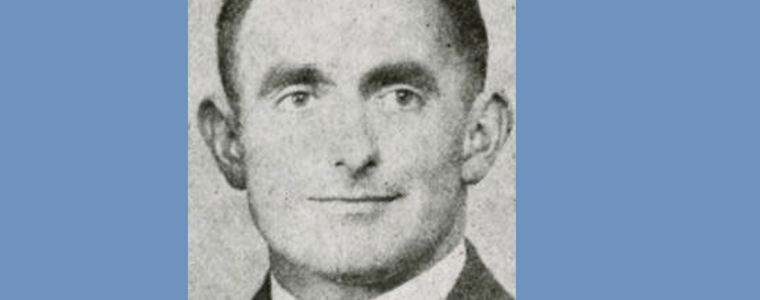
There will be a gathering at RAF Wyton on 16 December this year to honour the 75th anniversary of Black Thursday, and of the death of Ernest Alfred Deverill and so many other fine aircrew.

The exact details and timings are being finalised but it is planned that there will be a memorial service in the morning, lunch, and then an extended tour round the Pathfinder Collection at the Heritage Centre, including viewing the Deverill Collection.

The RAF Pathfinders Archive bought the very expensive (but, in terms of true value, priceless) Deverill Collection at the end of 2017. By purchasing it, we have ensured its future as a single Collection when today similar collections are being broken up to gain the maximum commercial value. We still need to raise another £11,000 to fund the purchase, which was made possible by means of interest-free loans from supporters.

Before the 75th Anniversary, we will be publishing “Ernest Alfred Deverill, the Pathfinders, and Black Thursday”, which will be available in November. All profits from this publication will go towards settling the outstanding loans. The price will be £10 plus postage.

Numbers for the 75th Anniversary gathering are strictly limited, so please notify us as soon as possible of your interest. If you would like to attend the gathering, preorder “Ernest Alfred Deverill, the Pathfinders, and Black Thursday”, or make a donation, please contact us on info@raf-pathfindersarchive.com or use the Support Us Page

Please note, the Heritage Centre is inside the Wyton base, which operates at a high security level. For further details see OUR PARTNERS



Link Between 7 Squadron and Churchill

Research often turns up the strangest connections. I was looking for information about Frederick Denzil James Thompson, a PFF Navigator with DFC and Bar, who was the son of Churchill’s bodyguard, Detective Inspector Walter Henry Thompson.  Thompson senior had a distinguished career, first acting as bodyguard to Lloyd George, and then later to Churchill almost continuously from 1921 to 1945. I had heard that Frederick Thompson the son, had lost his life, flying on PFF operations. SEE THIS PAGE.


Unknown PFF Crew at Wedding

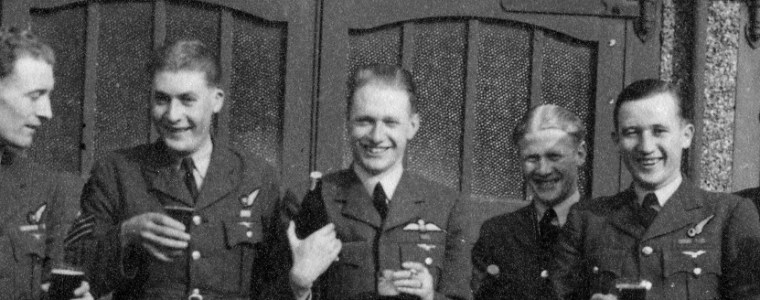
We have received a delightful picture of an unknown PFF bomber crew. It is cheerful, happy and informal, and the crew are obviously close friends.

Sent by Paul Smith, it was taken in early 1944 as his father, the young boy in the photo, was born in April 1942 and he is about two years old in the picture. Full-sized image.


Mosquito Week ends

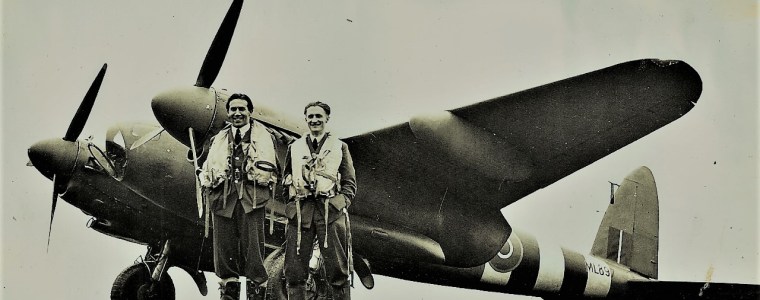
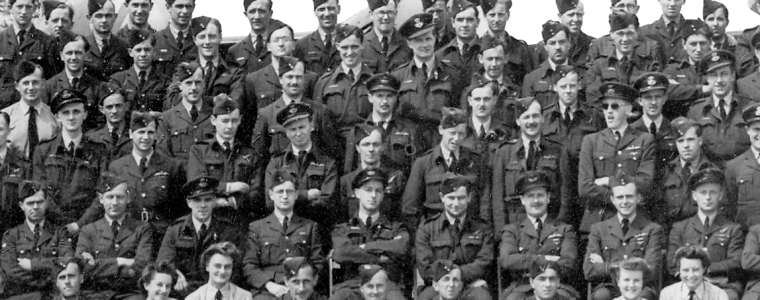
After a very successful Mosquito Week, we are saying goodbye to the Wooden Wonder for a few days and looking at some other topics. Our farewell photograph comes from 627 Squadron: 627 Squadron: Aircrew and Ground Crew

We will, of course, be adding further Mosquito material to the website in the near future. Amongst other features will be “‘Soldier of Orange’ – Erik Hazelhoff-Roelfzema” and “Ten Things You Didn’t Know About Mosquitoes”, both by Ross Sharp of the People’s Mosquito. We look forward to publishing them both and to welcoming Ross as a contributor.


Mosquito Squadrons & Oboe

To refine their accuracy in marking the targets, the Pathfinders used sophisticated navigational aids, one of which was Oboe. 109 Squadron, flying Oboe-fitted Mosquitoes, were often leaders in the bombing raids, and they had a number of star aircrew, including Group Captain H Bufton, one of Oboe’s pioneers. See our new page for Mosquito Week: Mosquito Squadrons & Oboe

RAF Accident Report, Parlato and Orchard

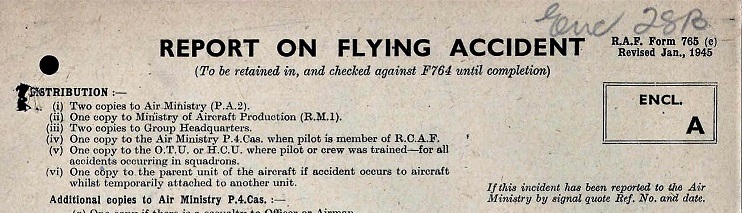
This report is not only of great interest because of the men involved in this particular accident, but also because it shows us the type of report which was compiled on flying accidents by the RAF. Unfortunately, due to the post-war ‘slash and burn’ attitude of the British towards their RAF records, this type of information is extraordinarily hard to obtain on RAF aircrew and it is usually only by going to the Dominion records (if a Dominion airman was on that crew) that one can get information on what happened.

See our new page: RAF Accident Reports: Parlato and Orchard

The People’s Mosquito

Here is something well worthy of attention during our Mosquito Week.

The People’s Mosquito has a simple vision (and a great many highly qualified and enthusiastic people to back it up): to not only return a de Havilland Mosquito to the skies above Britain, but, for the first time in more than 75 years, build this iconic aircraft in the UK.

People with long memories may remember the crash at an airshow on 21 July 1996 of the last airworthy Mosquito in the world. Sadly both men in the aircraft were killed and the Mosquito itself was totally destroyed.

At the time it looked as if Mosquitoes would never again be seen flying in this country.  And so this is where the People’s Mosquito comes in, a not-for-profit restoration project and registered charity.

They have an excellent informative website: The People’s Mosquito website. Of particular interest to me personally is this page featuring the entire film shot by Brian Harris, DFC, when he was a navigator on Mosquitoes with 627 Squadron in August 1944. 627 Squadron was one of the Pathfinder Mosquito squadrons ‘loaned’ to 5 Group in April 1944. 5 Group was always vastly more keen on PR and publicity than 8 Group. This is probably the reason why such a film was shot under Cochrane’s auspices, rather than Bennett’s.

mosquito

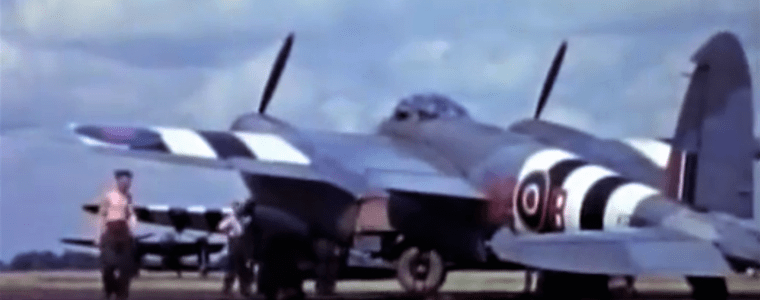
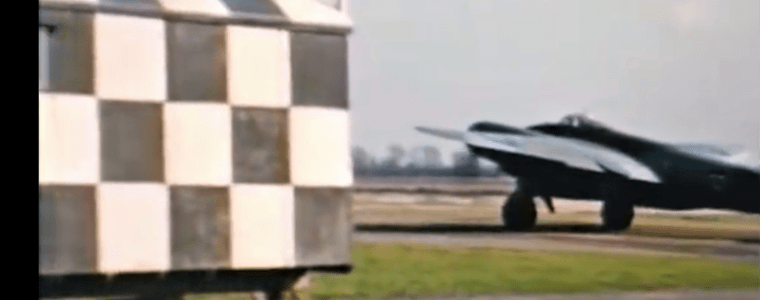
The film shows Mosquitoes preparing and then flying on the raid on Deelen airfield in Holland at mid-day on 15 August 1944. This raid was took place as part of the preparations for Operation Market Garden, the operation to capture several Dutch bridges including that at Arnhem. Deelen airfield was used as a base for German fighters. Following several raids that month, the airfield was put out of commission for fighter aircraft.

One of the many fascinations of the film is seeing Mosquitoes and ground crew in colour, not to mention the historical landscape known so well to Bomber Command aircrew, including Cambridge colleges and Lincoln Cathedral.

JENNIE MACK GRAY

Illustrations: stills from the film. 

Mossie Week, Continued

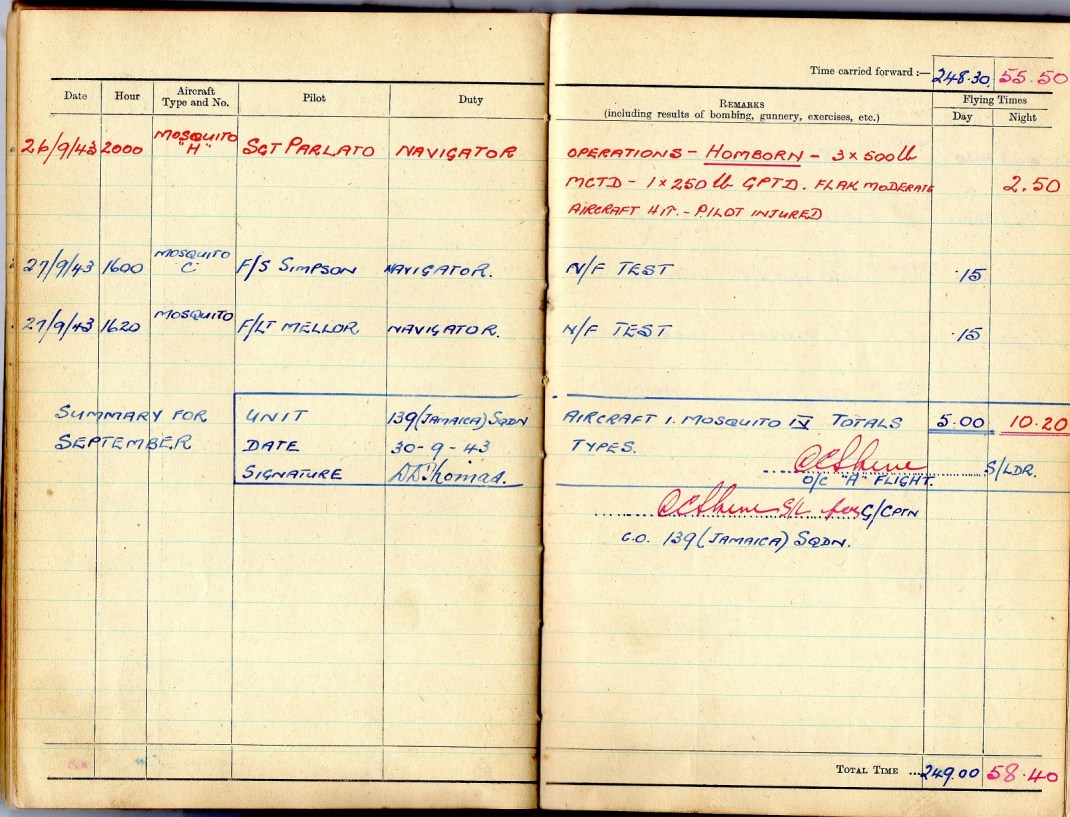
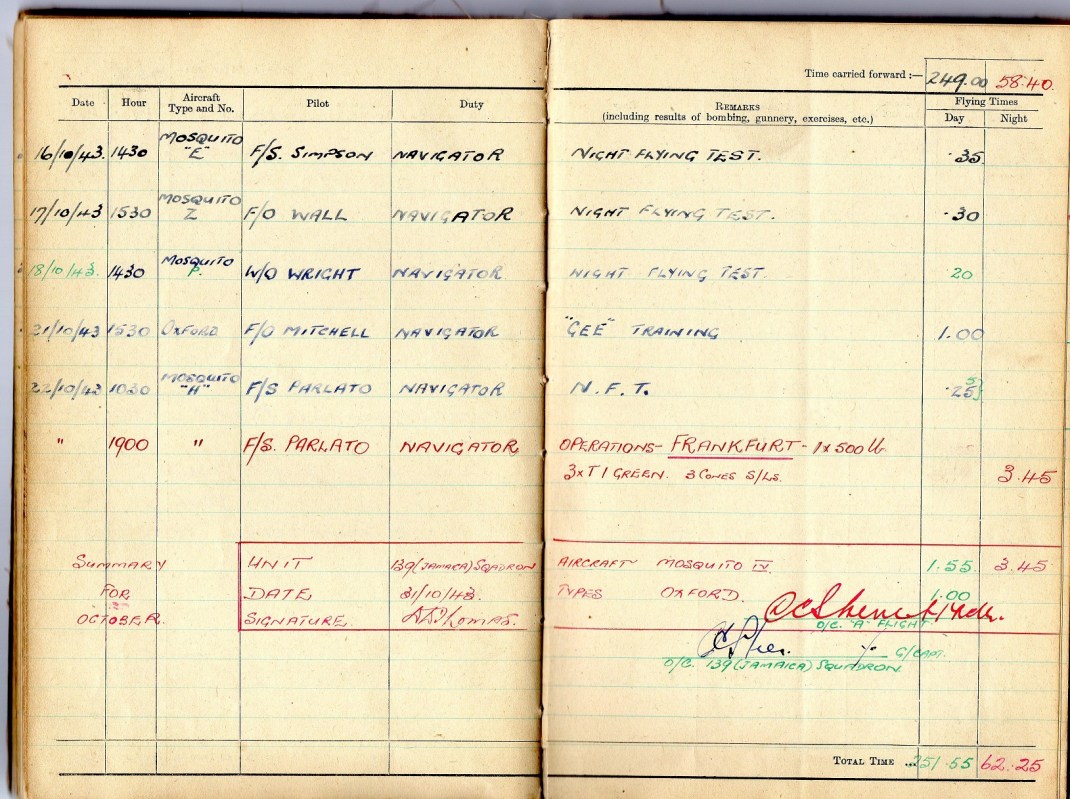
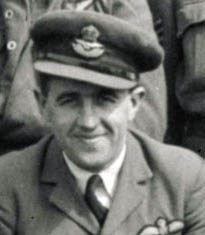
Further to yesterday’s post, which included photos of Dai Thomas and Sid Parlato, here is a page in Dai Thomas’s logbook, made when he and his pilot, Sid Parlato, were at 139 Squadron at Wyton during September to November 1943.

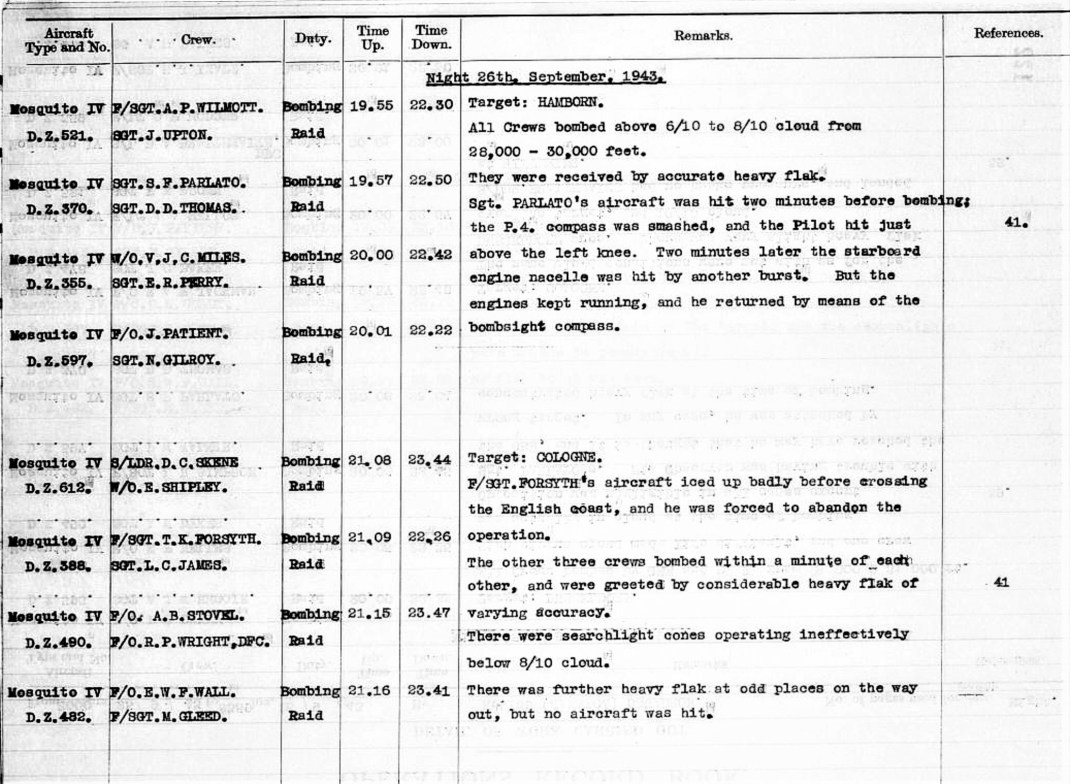
Mosquitoes relied on their speed and agility to get them out of trouble, but on 26 September the crew was unlucky. The first entry in the logbook page below tells of the aircraft being hit by flak, and the pilot (Sid Parlato) being injured. The corresponding entry in Sid Parlato’s logbook is believed to read: ‘Moderate flak. Aircraft hit including self.’

log book sept 1943

The deadpan factual nature of the comments is very striking. However, it is clear from the gap in the crew’s operations afterwards that something far from trivial had happened.

Looking up 627 Squadron’s ORB, we find a brief description of the incident, including the detail that Sid Parlato had been hit just above the left knee and that there had been considerable damage to the aircraft:

627 Squadron ORB September 1943

Perhaps on the same principle as you need to get back on a horse after a fall, Dai Thomas was flying the following day on an NFT (Night Flying Test) with a different pilot. Apart from one further NFT, his logbook does not show him flying again until 16 October, and then only on NFTs and Gee training, also with different pilots.

Finally,  Sid Parlato rejoined him on 22 October, close to a month after the Homborn flight in which he had been injured. They flew an NFT together and then an operation against Frankfurt, after which the normal pattern of ops resumed.

Enormous courage and a strong sense of duty were what it took to be Pathfinders.

logbook october 1943

Logbook images courtesy of Michael Thomas.