Posts

Mosquito Week

We’re having a Mosquito week this week, inspired by the wonderful project The People’s Mosquito which we will  be giving more details of in the coming days.

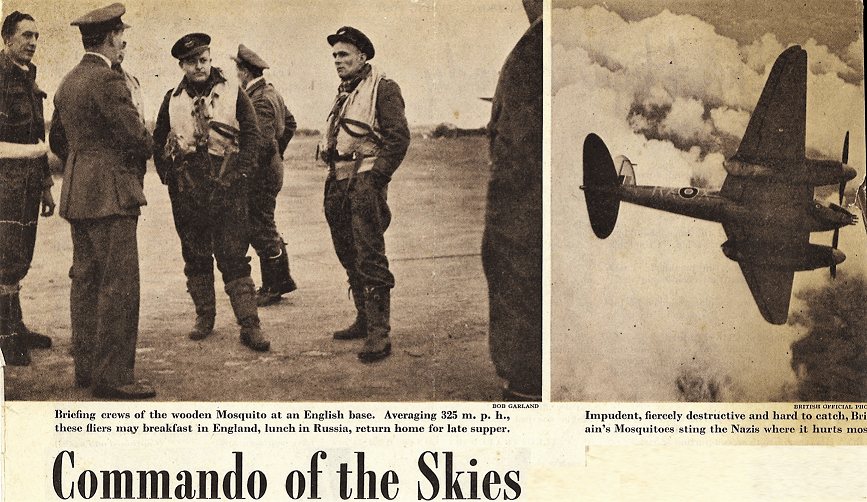
Below: article in an American paper, the Evening Post, 3 March 1945. Dai Thomas on the far left of the group. Courtesy of Michael Thomas. 

dai thomas, US evening post 2

Superstitions and Lucky Mascots

From ‘Beating the Odds: Superstition and Human Agency in RAF Bomber Command, 1942-1945 by S P MacKenzie, WAR IN HISTORY, 2015. Mackenzie makes the case that Bomber Command superstitions and mascots kept crews flying when the odds were stacked against them, and that this is why the authorities made no attempt to ‘curtail’ them (although frankly it is somewhat hard to see exactly how the authorities could have stopped crews believing in rituals and magic objects).

There was […] sound logic behind the widespread fear of flying with different crews and with strange aircraft. Ever since being brought together late in their training, the five or seven members of the bomber crew had been operating as a unit both in the air and on the ground. They had grown to recognise each other’s strengths and weaknesses, quirks and habits, and thereby had developed a significant degree of mutual trust.

Flying in so-called scratch crews, made up of comparative strangers, or even going out as a last-minute substitute with an established crew, was rightly considered risky. The scratch crew necessarily would lack the level of coordination and personal understanding present in most established crews. Hence [one navigator’s] desperate desire to avoid being left behind by his crew despite a foot injury because of his fear that as a result “I would end up as a spare and that was a sure way of getting the chop.” […]

Even charms, talismans and mascots were not entirely a matter of superstition. In a great number of cases they had been given to the individual concerned by a loved one, and thereby provided a link with the world beyond the war and thus a degree of emotional sustenance.

Illustrations, 97 Squadron lucky mascots, living at RAF Station Bourn at around the same time in 1943. Above, the bomb aimer Billy Colson’s good luck pig, ‘Giness Gutz’ (Guinness Guts), complete with tiny bomb symbols, now on display at the Pathfinder Collection at RAF Wyton. And below, the Jones’ crew mascot ‘Ken’, in private hands. Ken lived in the toolbox of the flight engineer, Maurice Hemming. With thanks to David Layne for the copy of the article. 

dougJonescrewmascot


Bennett and the Tirpitz

Leadership was a key quality in sustaining aircrew morale, and the commander of the Pathfinders, Don Bennett, was above all things an inspirational leader. He had immense courage and steadfastness of nerve. In his book Pathfinder, he tells the story of  being shot down whilst attacking the Tirpitz, giving the details very plainly without any hint of ‘line-shooting’  (‘line-shooting’ was the RAF wartime term for bragging, any suggestion of which was deeply detested by aircrew).

At that time, Bennett was the commander of 10 Squadron stationed at Leeming. The attack on the Tirpitz took place on 27/28 April 1942. The crew of Bennett’s Halifax were:

W/C D C T Bennett, Sgt H Walmsley (2nd Pilot), F/Sgt J Colgan (F/E), Sgt T H A Eyles (Nav), Sgt C R S Forbes (W/op), Sgt J D Murray RCAF and F/Lt H G How (gunners)

As Bennett’s aircraft approached the ship, it was hit many times and the tail gunner wounded. In a masterpiece of understatement, Bennett summed this up as ‘things were far from peaceful’.

The Tirpitz was hidden by a defensive smoke screen, and was almost impossible to locate exactly. Bennett’s calibre is shown by the fact that even though his aircraft was on fire and badly damaged, he still went round to try a second run. He released the mines as best as possible, then turned east towards neutral Sweden. Things were so bad that he then gave the order ‘Prepare to abandon aircraft’.

I regret to say that one member of the crew became a little melodramatic. He said, ‘Cheerio, chaps; this is it, we’ve had it.’ I told him very peremptorily to shut up and not to be a fool, that we were perfectly all right but that we would have to parachute.

Because the tail gunner, Flight Lieutenant How, was badly wounded, Bennett kept the aircraft in the air as long as possible so that How could escape with the aid of the flight engineer, Flight Sergeant Colgan. Bennett finally jumped just as the aircraft began to break up.

After baling out, he chanced across his w/op Sergeant Forbes in the darkness. At first both of them thought that the other was a German.

Suddenly I realised that he was one of my own crew, and I said, ‘It’s all right. It’s your Wing-co, it’s your Wing-co.’

The story of the two men’s trek through deep snow  is deeply engrossing. After many hardships, and the assistance of the Norwegian people, they made it through to neutral Sweden.

All the crew of seven survived. Four, including Bennett, made it back to England, the rest were captured. Bennett arrived back in England exactly one month after he had been shot down. He immediately hitched a ride in an Anson down to Leeming where his wife and children lived.

The Intelligence boys were furious that I had not reported immediately to London to be interrogated. I could not have cared less.

Only two months later, he was given command of the Pathfinders.
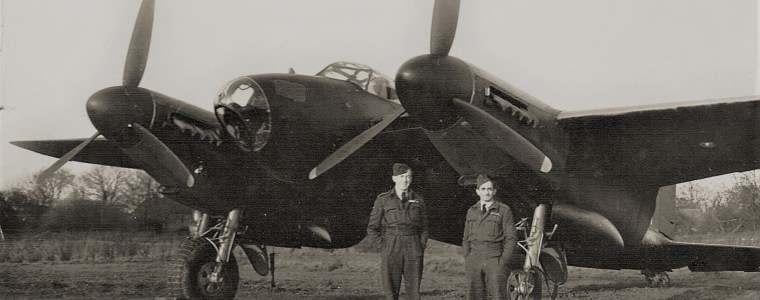
Donald Schofield Barker, 582 Squadron

Donald Barker, a navigator, has been identified in the group photograph of 582 Squadron taken on VE Day. This is highly unusual as the identities of the men in these wonderful squadron photographs tends to be lost over the years if not noted down at the time. Another member of the squadron was clearly a close friend, and appears in the holiday photograph above. Unfortunately, this is not a happy story although both men survived the war. See Donald Schofield Barker page.

The Peenemünde Raid , 17/18 August 1943

One of the reasons why Bennett may have been late in sending the message about the first anniversary of the Pathfinders (see previous post) is that he may have been preoccupied with the Peenemünde raid, which took place around the same time. As the raid is so well known, we have looked at it from a slightly different angle: what happened after one particular crew left the target. Debriefing after the Peenemünde Raid, 17/18 August 1943


First Anniversary of the PFF, 1943

15 August will be the 76th anniversary of the creation of the Path Finder Force in 1942. In 1943, the year after the Force was formed, slightly belatedly Bennett sent a Special Order of the Day to his squadrons, saying that much had been achieved but more needed to be done. The text was copied into the squadrons’ ORBs.

Entered into 97 Squadron’s Operations Record Book on 22 August 1943:

Special Order of the Day by Air Commodore D.C.T.Bennett CBE, DSO, Commanding Path Finder Force

“To all ranks of the PFF.  On the 15th August 1942, five squadrons, each representing a group in Bomber Command, assembled on allotted aerodromes to form the PFF.  In one year the PFF has played a large part in showing the enemy how effective bombing can be as a direct means of breaking his morale and thereby winning the war.  It is conceivable that he can crack up tomorrow.  On the other hand his Gestapo rule may make it possible for him to continue indefinitely.  Bombing is our most rapid and effective method of preventing his continued struggle but only if it is effective.  The PFF have done much but they must do more.  The quality of our bombing is in your hands.  Keep at it and good luck to you all.”

PFF Navigation Training Unit, NTU

The Path Finder Force had a training unit, the NTU, to teach the highly specialised Pathfinder techniques before the crews moved on to their Pathfinder squadrons. For most of its existence, the Unit was based at Warboys, also home for a while to the Mosquito Conversion Unit, the MCU.

Featured image, the King inspecting Warboys in February 1944.

75th Anniversary Black Thursday – Kirby & Stephens

Further to our post yesterday about Billy Colson, on Black Thursday he had taken the place of Ivor Glyn Stephens as bomb aimer on the Mackenzie crew. Stephens would survive the war, as would Keith Kirby, who had been in the aircraft with Billy Colson when it crashed. Severely injured, he seems to have made a full recovery. He married in a double wedding in which Glyn married Keith’s sister and Keith married her best friend.

Bennett on the PFF Mosquitoes

“The experts on the Air Staff who turned down the Mosquito as a type in the early days might be interested in the argument which subsequently became current to the effect that one Mosquito was worth seven Lancasters. For those mathematically minded, here is the exercise: A Mosquito carried a little over half the bomb load of a Lancaster to Berlin. Its casualty rate was about 1/10th of that of the Lancaster. Its cost was 1/3rd of the Lancaster, and it carried two people in its crew instead of seven.”

To read more, see our new Page: Bennett on the PFF’s Mosquitoes